


We arrived in Sarajevo by bus on a shivering October evening under the canopy of midnight. Void of sounds, the only thing we could hear was the echo of our footsteps as we searched for the hostel amongst a whisper of shadows. The buildings around us were littered with holes from mortar shells and the air had a tinge of eeriness, making the city difficult to read. As the night got darker and the wind picked up, we navigated the streets in search of our refuge. That’s when it dawned on me I’d never once seen any photos of Sarajevo before booking this trip.
The next day as the first rays of light danced upon the street, I wondered if yesterday’s arrival had just been a dream. Everything looked different. In the sunshine, dozens of people sat on café terraces with tiny copper coffee cups enjoying their morning ćejf, the Bosnian ritual of slowing down and finding joy. The passersby were incredibly tall and impeccably well dressed. The sky was a cloudless blue and the horizon lined with minaret towers as the call to prayer echoed around us and the city came to life.
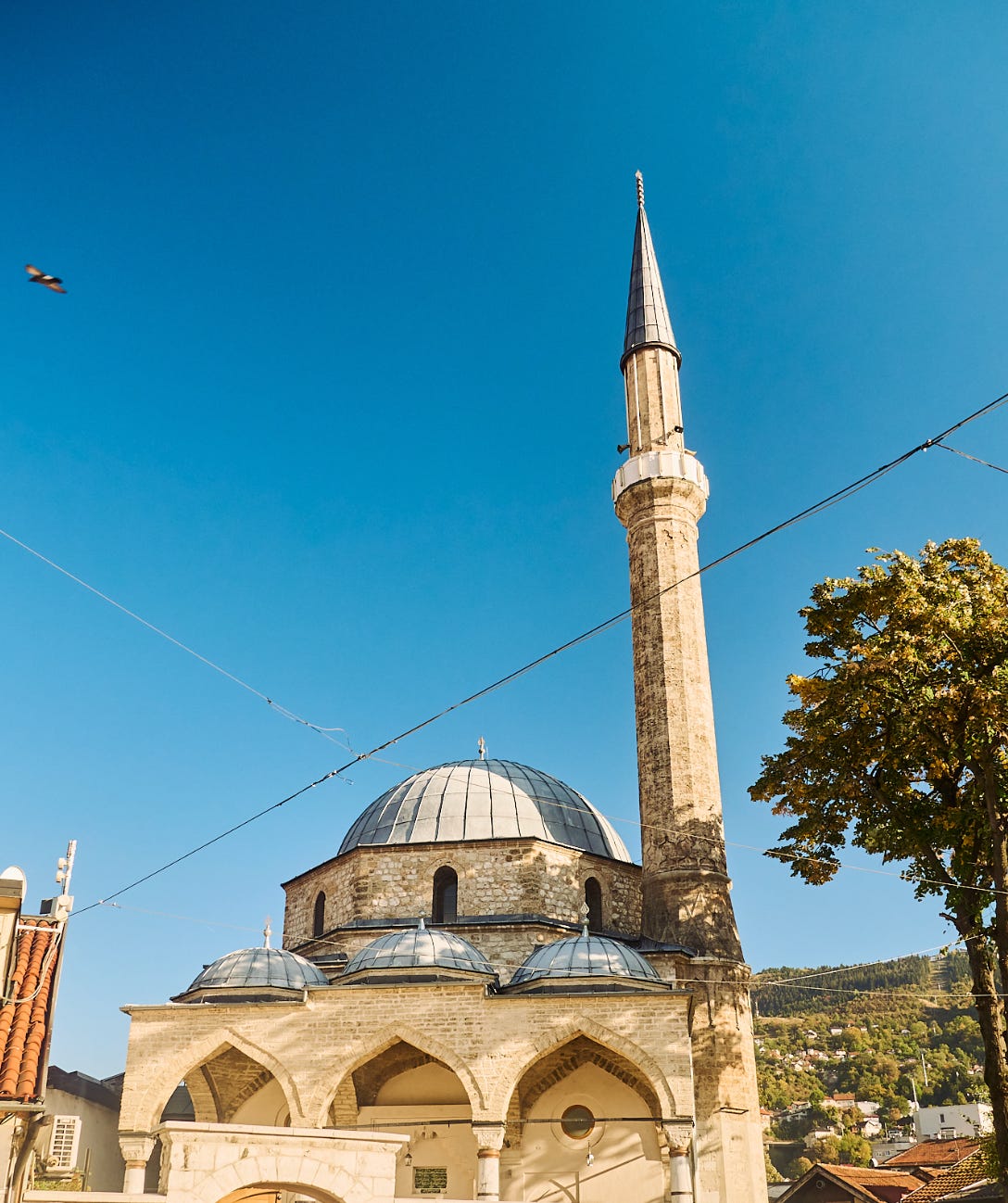
My friend Nellie and I arrived in Sarajevo without expectations and full of curiosity. Our days often teeter-tottered from moments of gloom and heavy darkness relating to the war and genocide in the 1990s, to signs of light in the bustling city and slivers of hope for the path ahead.
The people who opened the doors of this contrasting city and helped us get acquainted with it’s mysteries, became the Sarajevo coppersmiths. We didn’t know anything about them before, but we quickly discovered they are the keepers of the keys to some of Sarajevo’s history and culture. Guardians of the past, present, and future.
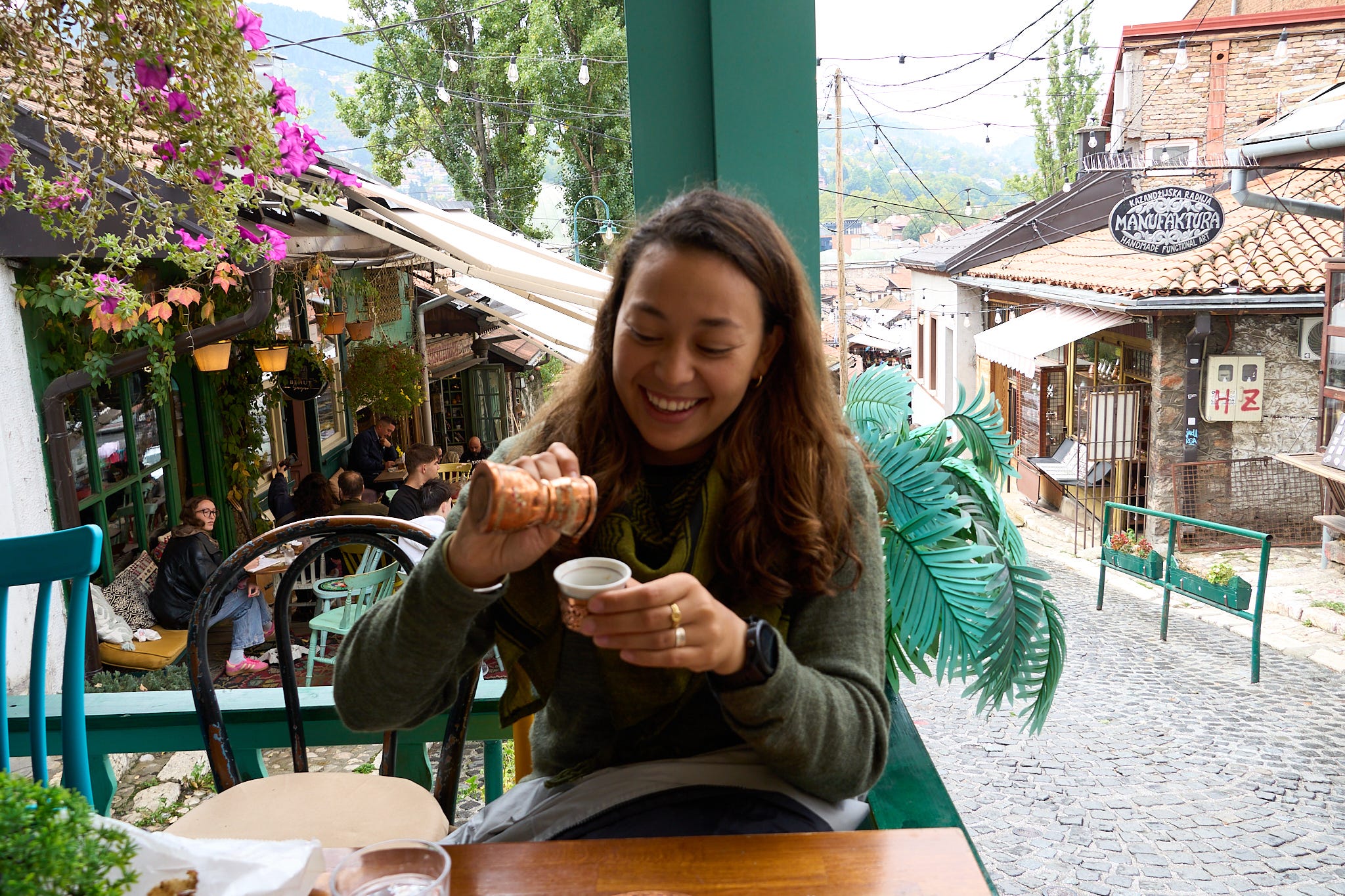
We originally stumbled upon the coppersmiths because I wanted to buy a copper mortar and pestle. The only thing I had looked up on Google Maps before arriving in Sarajevo had been where to buy one, and Google Maps indicated the famous copper street, Kazandžiluk. But when Nellie and I went there, we both felt the energy was strange on that street. It was clearly popular and crowded, but the shopkeepers didn’t feel too keen for conversation and felt like they just wanted to make a quick sale. It wasn’t until later, when we went looking around for a coffee, that we stumbled upon a hilly cobblestone street which housed another handful of copper workshops. It’s here where we met and befriended Eldin, Nermina, Abdullah, and Fig Man.
Abdullah
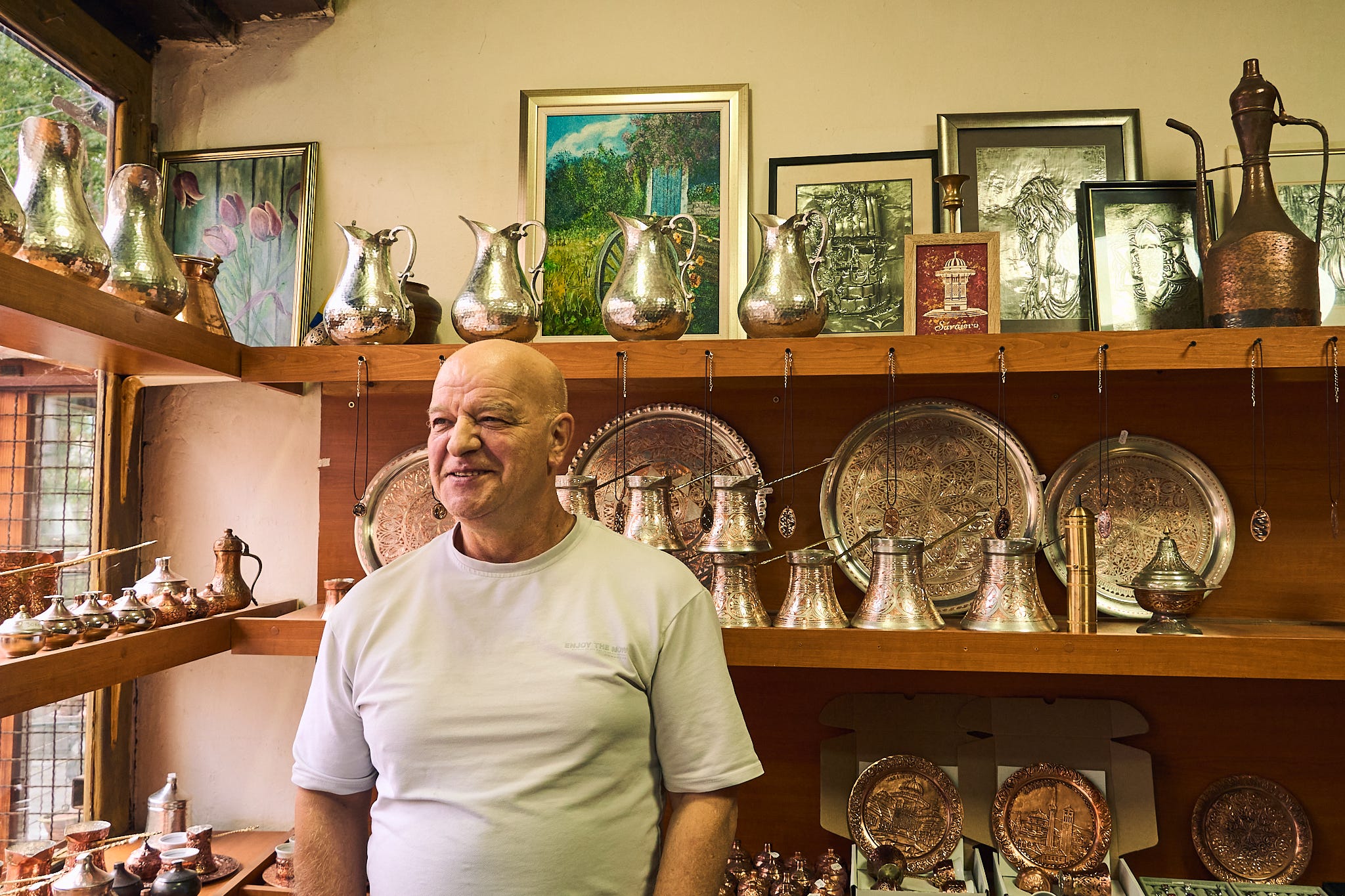
The first coppersmith we met was Abdullah. He is probably in his mid sixties and told us he had only started learning the craft a few years ago. But as we watched him expertly engrave trays by hand on his stone workbench, we would have guessed he had decades of experience. When we got to talking about whether he enjoyed his work, he looked up with a twinkle in his blue eyes and said, “Joy is base for good health.”
After buying a few coffee cups from him, we asked where he’d recommend we eat. He sent us to a small restaurant called the Singing Nettle. That night, I couldn’t stop drooling over the klepe, dumplings similar to Turkish manti, with stinging nettle pesto, and Nellie couldn’t stop admiring the copper plates our food arrived on.
Nermina


She’s the only female coppersmith in all of Bosnia. We stumbled upon her shop because in the window were silver handmade coffee pots with engravings, very different than the hammered copper-colored ones we’d seen everywhere else.
Nermina took over the shop from her father, one of Sarajevo’s oldest coppersmiths and her teacher, and is continuing his legacy. She told us that the Ottomans had brought coffee and the copper craft to Bosnia centuries ago, and at the peak there were hundreds of coppersmiths in the city and now fewer than thirty remain. A photo of her father hangs on the wall behind her workbench, and in the photo he is seen sitting in her very spot and using the same tools she uses now.
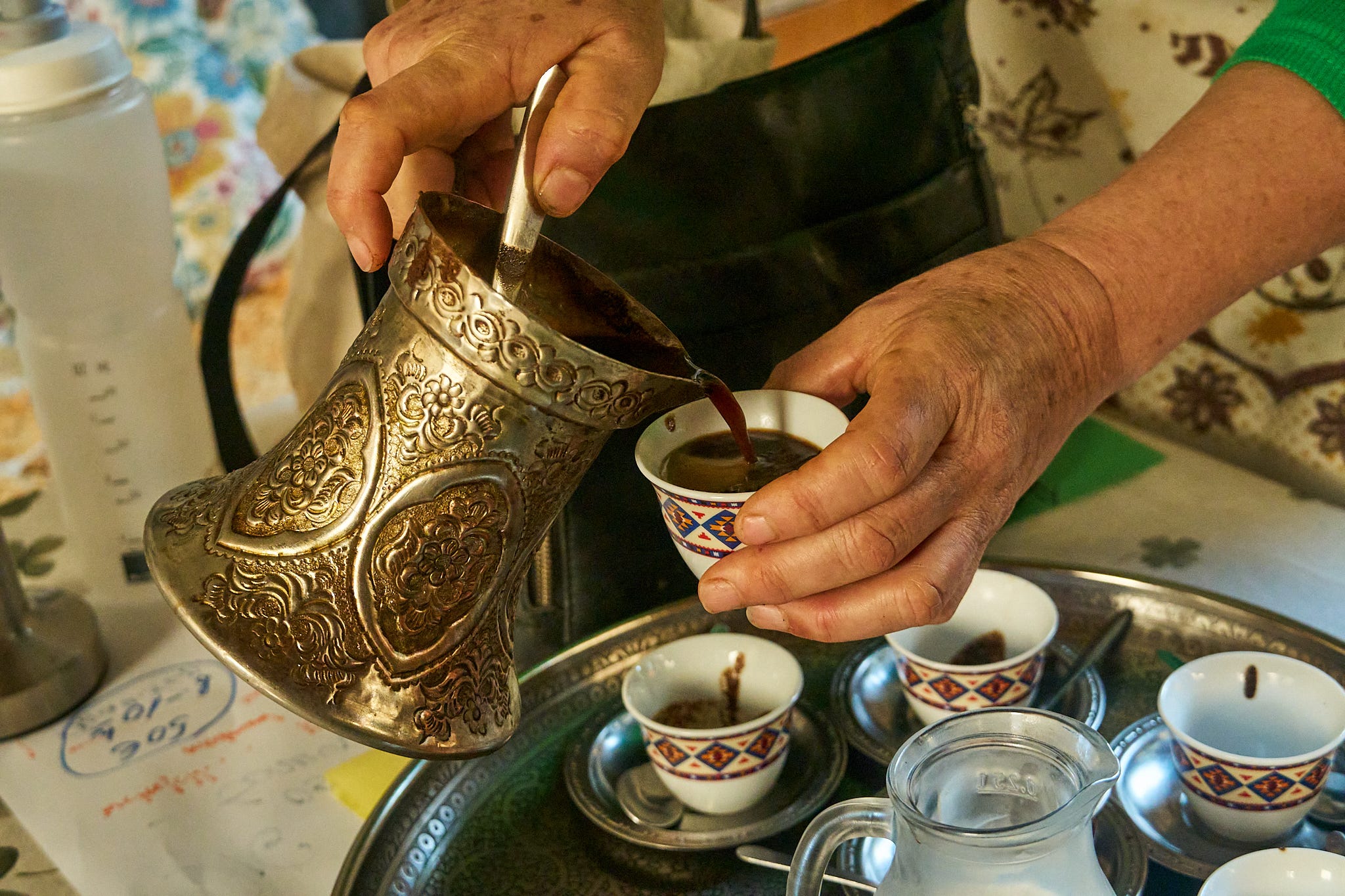
She was the only person who explained why Bosnian coffee cups are porcelain but sit inside a copper holder. “It’s because Bosnians love sitting with their coffee for a long time, so the copper keeps it warm,” she said.
Dino the Fig Man
At the very top of the Kovači hill is Dino who we nicknamed Fig Man because after we left his shop, he chased us down the street just to share with us the most exquisite gooey dried figs that his friend had brought him from another region of the country. Despite not speaking much English, the passion toward his craft shone incredibly strong and we later learned he is the youngest in a very ancient line of coppersmiths in his family.
Eldin
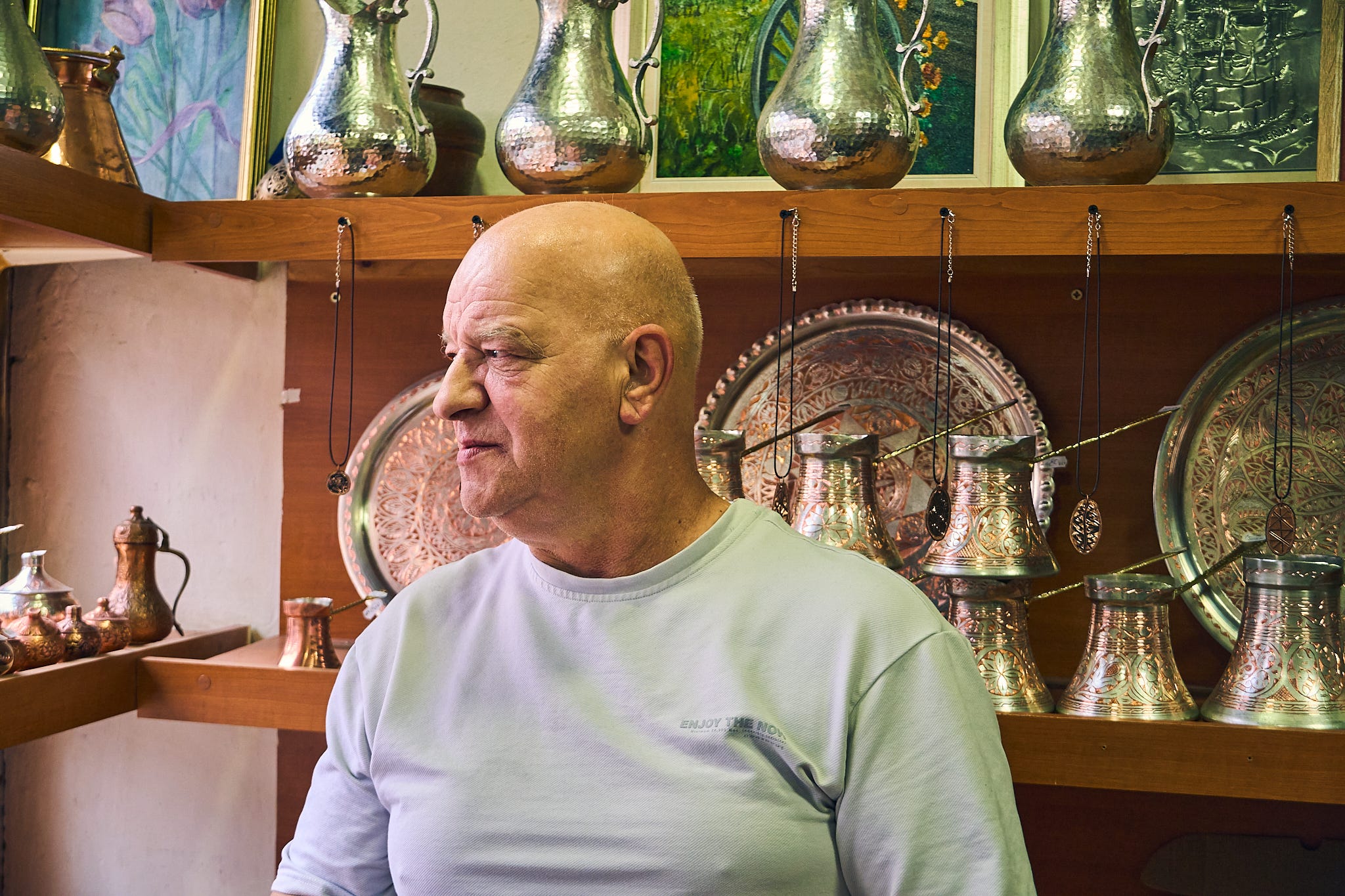
The last coppersmith we met is the one who put all the pieces of the puzzle together.
The second we walked in his shop at the bottom of the hill, we felt Eldin’s warmth and energy. His backstory is that his career before the war had been in television production. When the war started, he joined the army where he put to use his media skills. In 1996 after the war, he went back to working in television in the evenings, but during the days, he spent time with his 70-year-old neighbor who was a coppersmith.
Eldin learned everything from his neighbor. They spent their days talking, smoking, and making things. “After the war, making things with my hands is what saved me,” he said.
We talked with him for so long that his phone rang and it was his wife asking if he was making it to dinner. Apparently he was supposed to have closed the shop a long time ago but we were so immersed in conversation that he lost track of time.
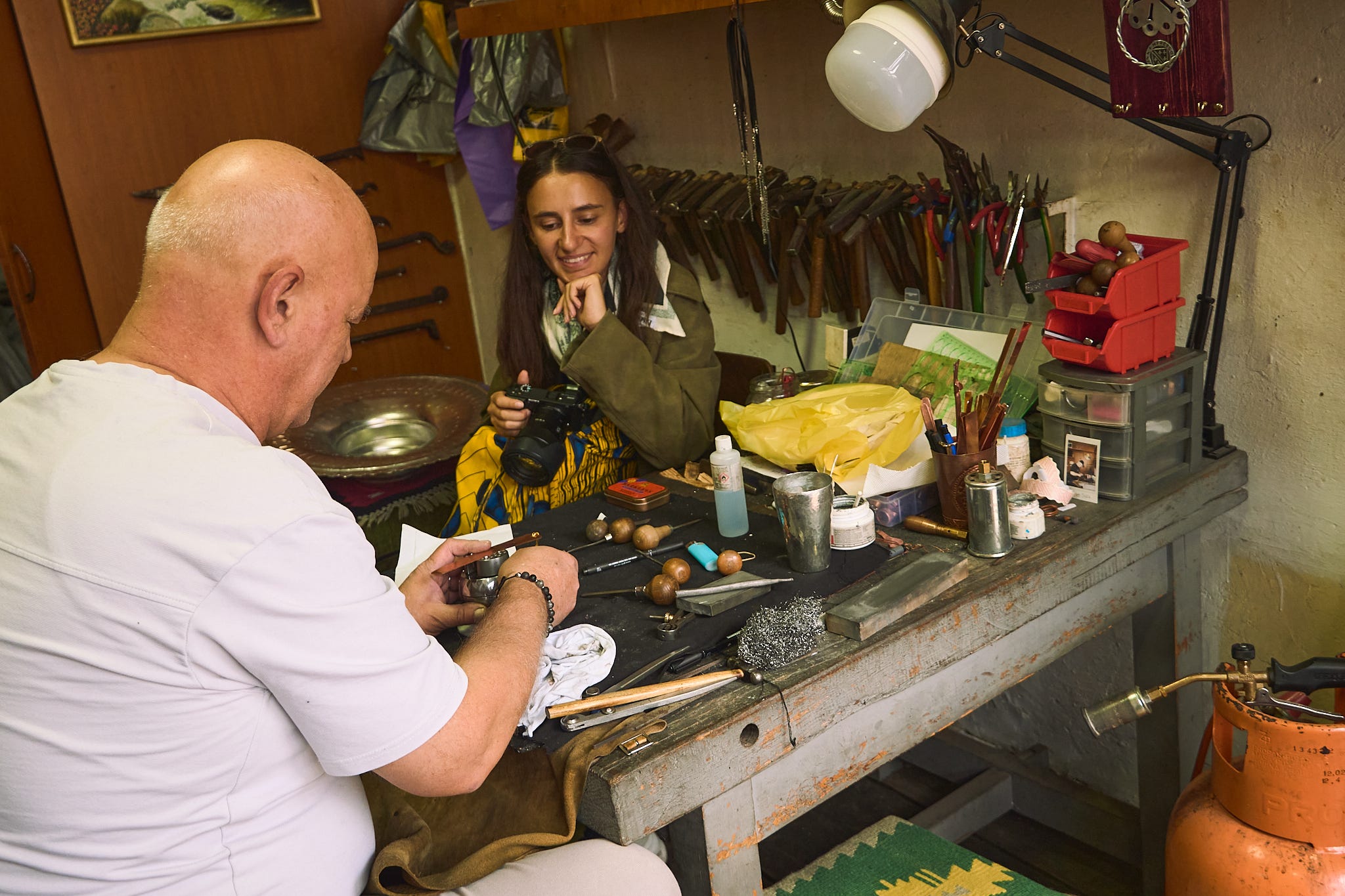
As the evening went on, Nellie and I reflected together about what Eldin had shared. We could feel he has a really good heart, that he cares not just about his trade but about the future of his country and humanity. We knew we had to talk with him again, but we were already leaving Sarajevo the next day and it was Sunday so the shops would be closed. But we plotted to wake up extra early and try our chances if he was in his shop.
I woke before sunrise only to see a gray sky and hear rain pelting the window. Still, we got dressed, grabbed our umbrellas and went out to the hilly coppersmith street to test our luck with Eldin.
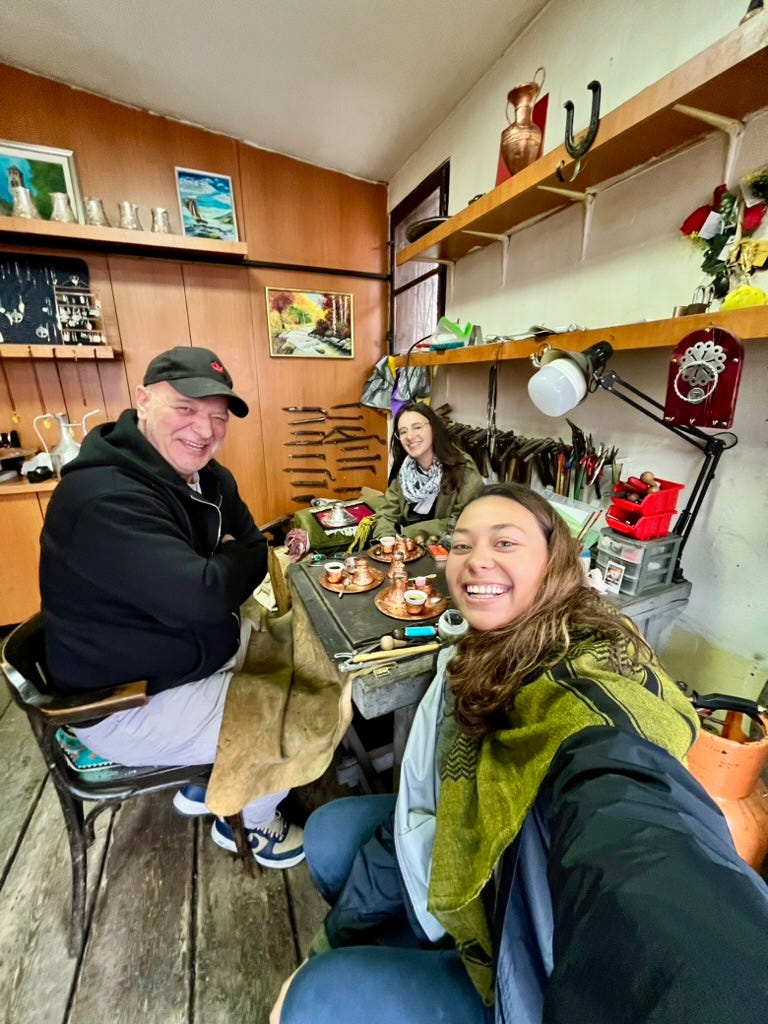
Tap tap. I knocked on his window where I spotted him hunched over working. I could see cigarette embers burning on an ashtray. He sprang from his workbench with a huge grin, pleasantly surprised to see us standing outside with our umbrellas. He welcomed us inside and pulled up a couple of little wooden stools for us to sit. He offered us cigarettes (which we politely declined), and coffee (which we eagerly accepted).
Eldin the coppersmith left us alone in his shop while he crossed the street in the rain and ran to the Ministry of Ćejf café to place an order. A little while later, someone came knocking and balancing a copper tray with three steaming hot Bosnian coffees complete with the perfect creamy foam on top and a side of Turkish delight.
It was there gathered around his workbench drinking coffee surrounded by puffs of smoke, where we learned more about Eldin’s life and shared conversations about the purpose of life and the complex thing that is being human.
So, how’s the weather?
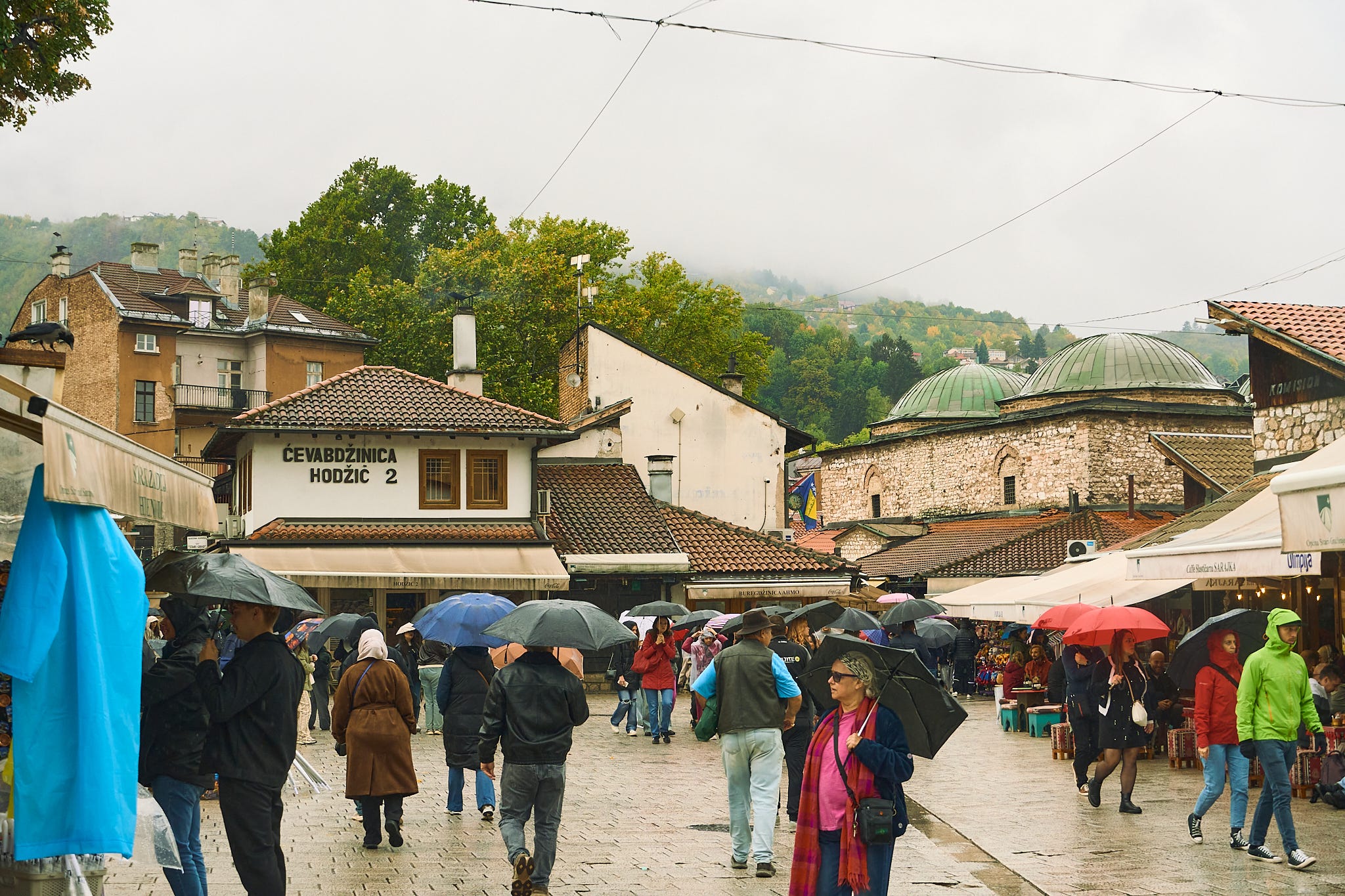
Like many conversations, it started with talking about the weather. He shared that before the war, the city had a lot of trees which helped keep it cool during summer. But that during the war, they had to chop down the trees to stay alive during winter and try to keep warm. That now with climate change, the summers are getting hotter and there are fewer trees to regulate the temperatures. He is concerned at how much climate change is affecting Sarajevo and that he sees it affecting his own work. “In summer it’s too hot to even use the copper spinner, so I can’t make new materials,” he said. “I’m worried about what climate change will do to our city and traditions in coming years.”
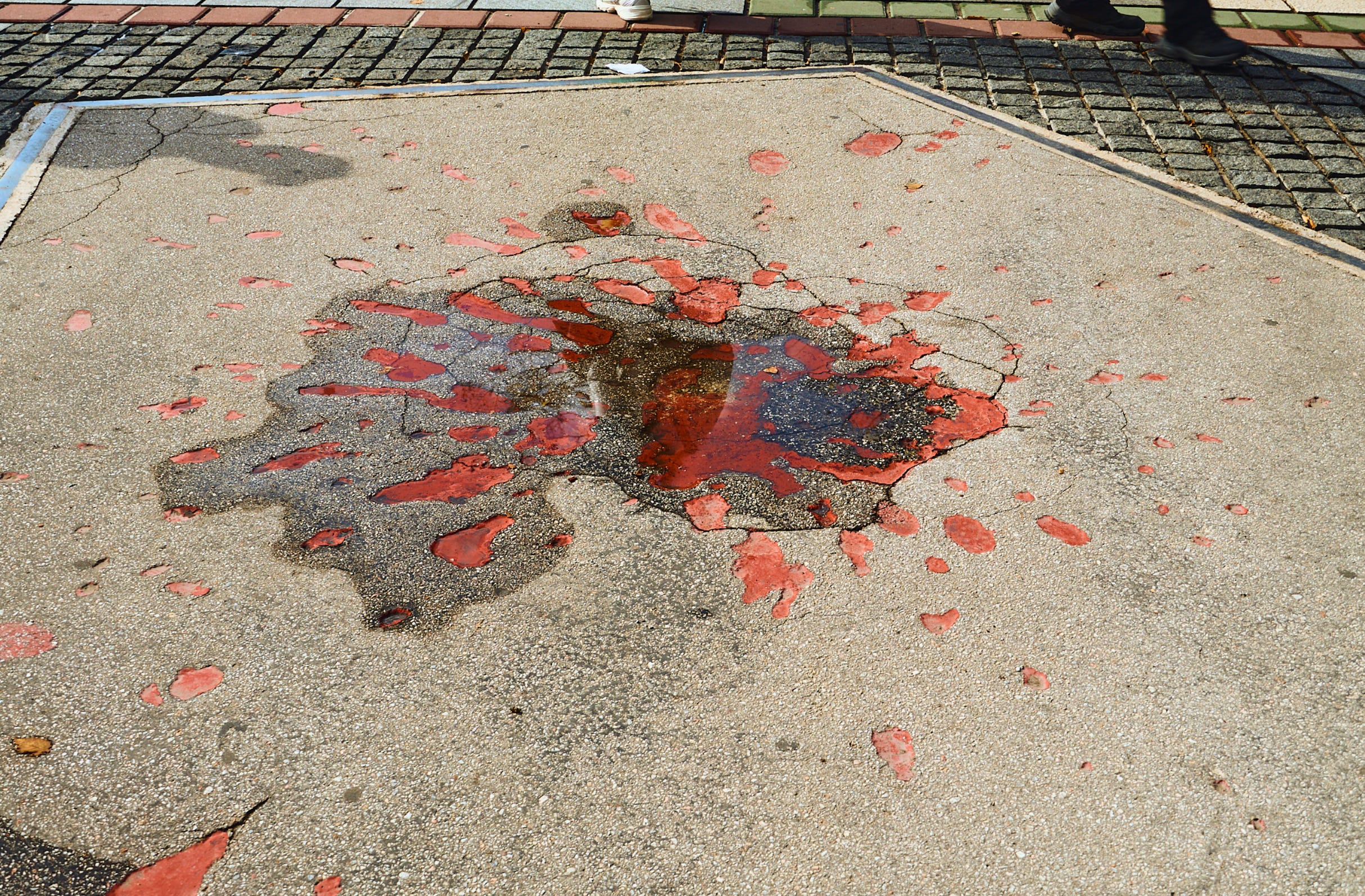
Eldin brought up the war and how brutal it had been trying to survive in harsh winter months and boiling summers without electricity, water, food, and basic necessities when the city was under siege. He lost many friends who are now buried at the cemetery at the top of the hill. He said others evacuated and left. But he also said he stayed because he couldn’t leave his aging parents behind, for they’d have no one to help them bring food and water. That even after the war, he felt the healing he had to do was right there in his home city. He discovered the path forward was keeping his hands busy through music and in copper work. Things that bring joy to him and to others.
“War brings very difficult times. We can’t forget it, but we have to move past it. Move forward from it,” Eldin said.
We talked about living in the analogue. “Learn to read sheet music, read books on paper, and talk to people,” he said. “I talk with people honestly every day over coffee. We need these human connections and bonds. It’s these things that give us reasons to live and find joy.”
Eldin said new generations aren’t interested in becoming coppersmiths. Many are searching for different futures like his son who is working as a software developer and likes traveling. But his other son is learning to make copper crafts and has a shop next door.
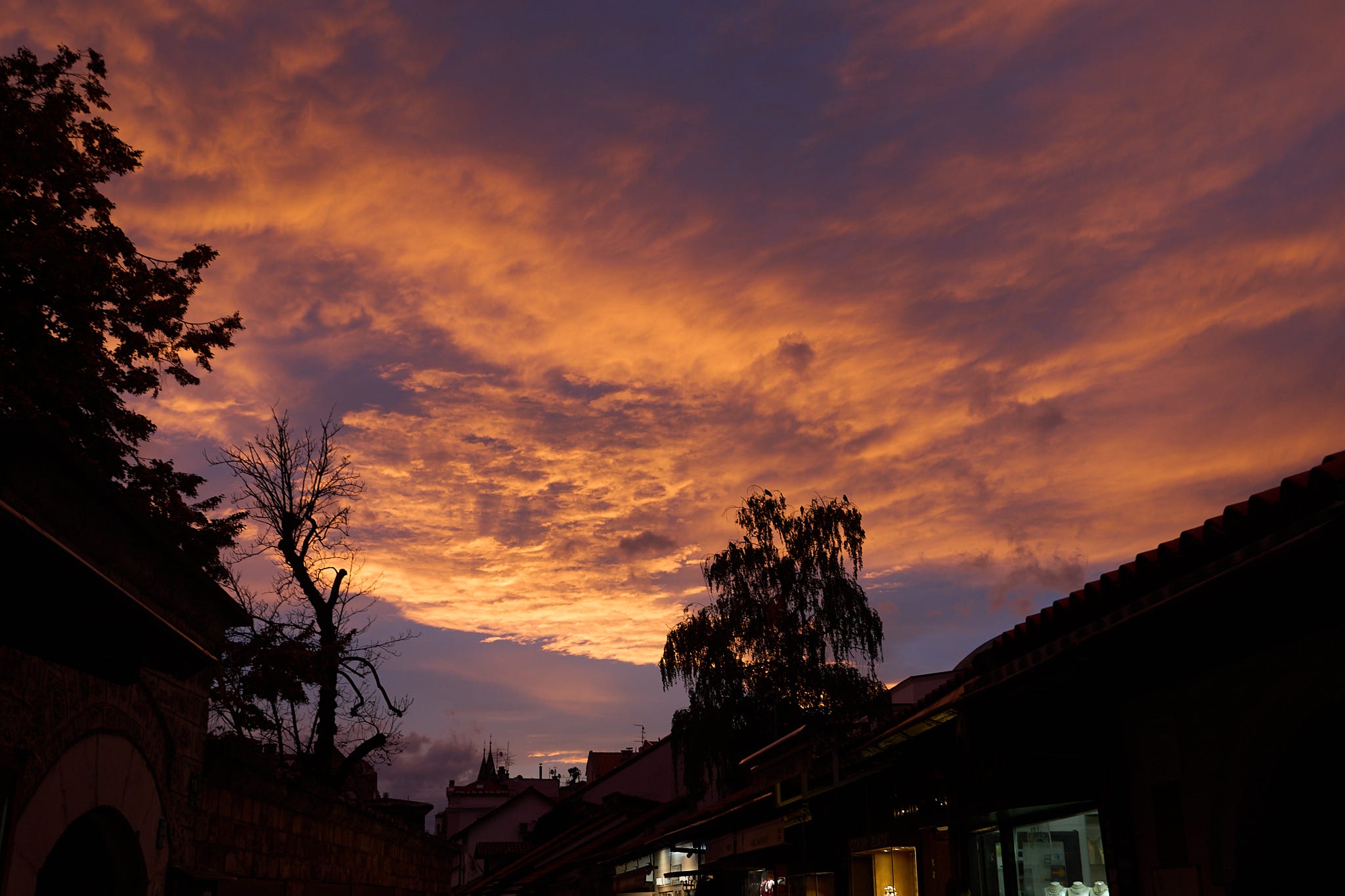
We could have stayed talking with Eldin for hours, but the clock was ticking and I needed to get to the airport. As we got up to say goodbye, Eldin looked us directly in the eyes said we need more young people to keep the essence of life alive. The humanity, the stories, the cultures, and the traditions. To preserve them. The way he said it made it apparent he was clearly talking about Nellie and me. About our responsibility to share these stories of cultures and people and traditions and wisdom.
The Disappearing Food
The night before, Nellie and I had gone back to the Singing Nettle for one last dinner. This time we stayed longer and chatted with the owner, Sabina. When the copper plates came up, she told us they were made by her friend Abdullah, the same coppersmith who had sent us there on our first day. She told us she used to work in marketing until she got tired of it. She loved food, so she created the Singing Nettle, a place to give life to the forgotten specialties of traditional Bosnian cuisine.
The Final Ćejf

Since leaving Sarajevo, I feel a quiet urgency to keep learning through people and places, the way Eldin does, over coffee and honest conversation. To him, life is about being kind to one another, about family and friendship, and about making time for the things we love, like making things with our hands and music. I think he was right that we need people to keep the essence of life alive. In a world more and more convinced that the future is AI, digital, and commercialization, the more convinced I am that I want to go the opposite way and keep chronicling these human moments.
Now I spend my mornings making Bosnian coffee in the pot I bought from Eldin and pouring it into the cups Abdullah and Nermina made. In my own little moments of ćejf, I take my time drinking it, the copper keeping it warm.
Love this. This is the kinda of travel that truly awakes us. Also shout out to Nermina 💁🏻♀️😎