


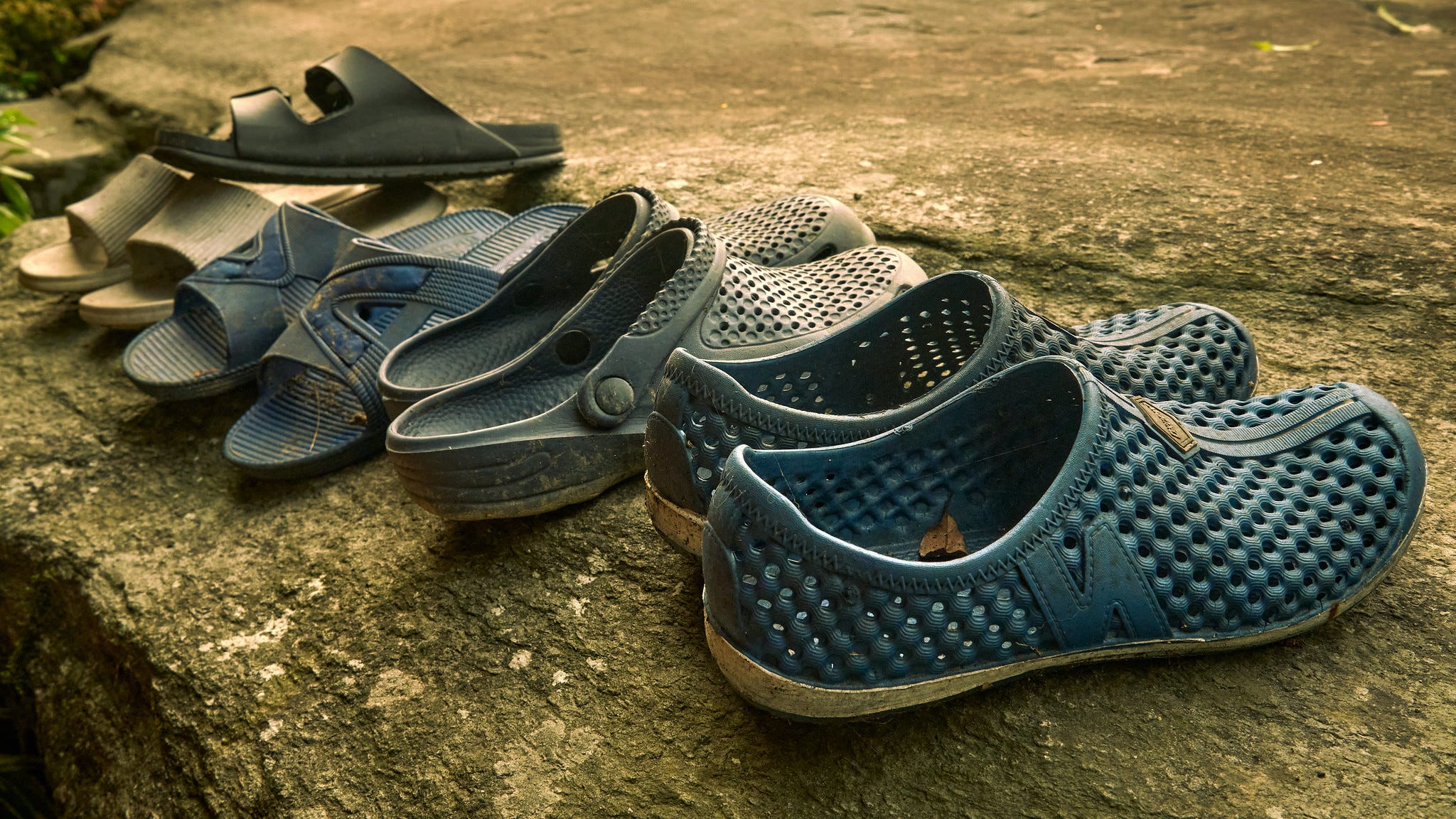
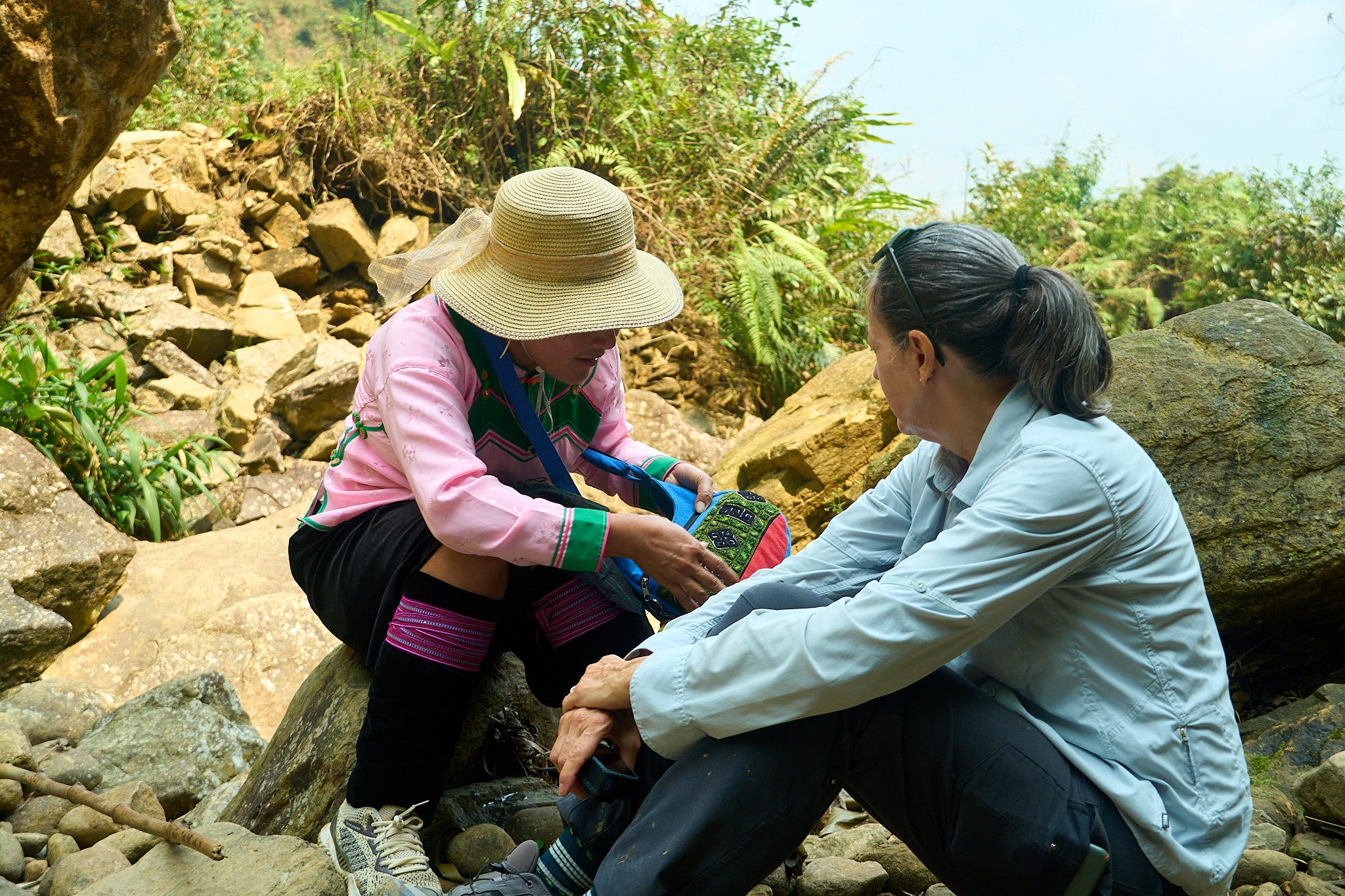
She walks more than fifteen miles a day. Her feet are her transportation as much as they are her livelihood. In Sapa, all the women seemed to wear plastic sandals. It doesn’t matter if they are so big their feet swim in them, or if they are so small the heel sticks out. We’d hardly settled down sitting on the grass facing the lake in Sapa, when an older Hmong woman in bright clothes, a backpack basket, and plastic sandals sat next to us and started a conversation.
It was she who said walking is her main form of transportation. It’s also how she earns a living as a Hmong trekking guide, taking visitors from around the world hiking through the mountains of her region for day hikes or multi-day hikes. For me, the image of a hiking guide is one with hiking pants, a technical sun shirt, trekking poles, sunglasses, a GPS, a hydration backpack full of carabiners and supplies, and a pair of hiking boots. This lady had none of that.
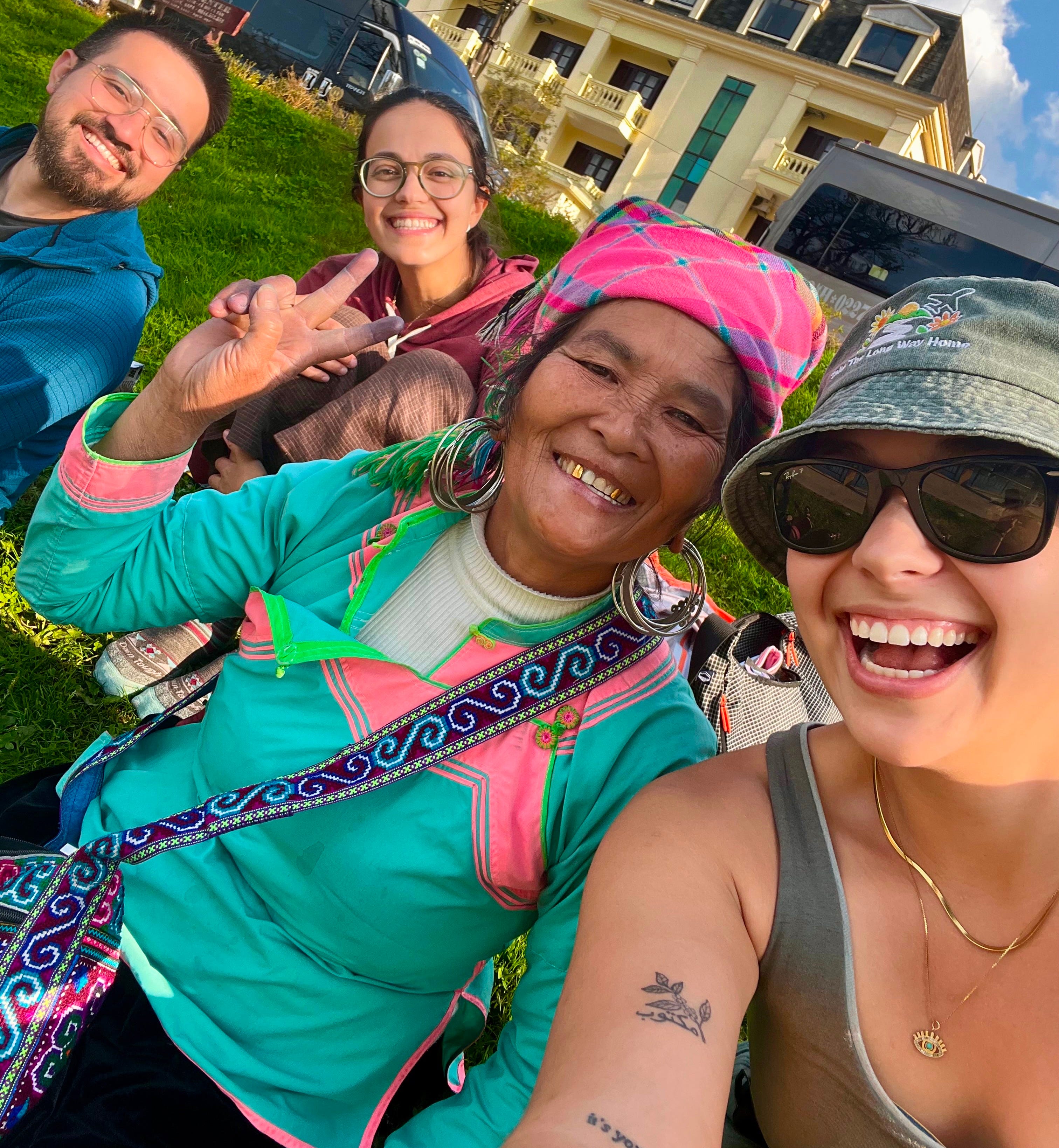
She wore an elaborate handmade neon pink and green long-sleeve shirt, her legs wrapped in what looked like black velvet strips, a lot of heavy-looking silver jewelry, and slide sandals that looked about two inches high. My sister and I tried to shorten the conversation, but she made herself comfortable sitting between the two of us in the grass. As the conversation went on, I couldn’t help but look at what I was wearing and what she was wearing.
When it became apparent she was hustling to get us to hire her as our trekking guide, I asked her about what she suggested we wear on the trek. Online Reddit threads and YouTube comments had told me to bring hiking shoes or boots to Sapa, yet I hadn’t listened and only had my Brooks running shoes with zero traction. I thought that worst case I could buy some hiking shoes in town and they’d probably be fairly cheap.
She laughed and pointed at her feet. “You’ll be fine! This is what I hike in!” She pointed at her flat plastic sandals.
I pointed to the mountains, “You hike up those mountains in those sandals?” I asked, half thinking she was joking. She smiled and said “Yes, no problem.”
The mountains around Sapa are not small. They are steep with hardly any switchbacks, and snake through rice terraces full of mud, jungle, and water buffalo poop. After hours of talking with the woman, we parted ways. While we didn’t end up hiring her as our guide, we did end up hiring another Hmong guide who offered a hike closer to our homestay.
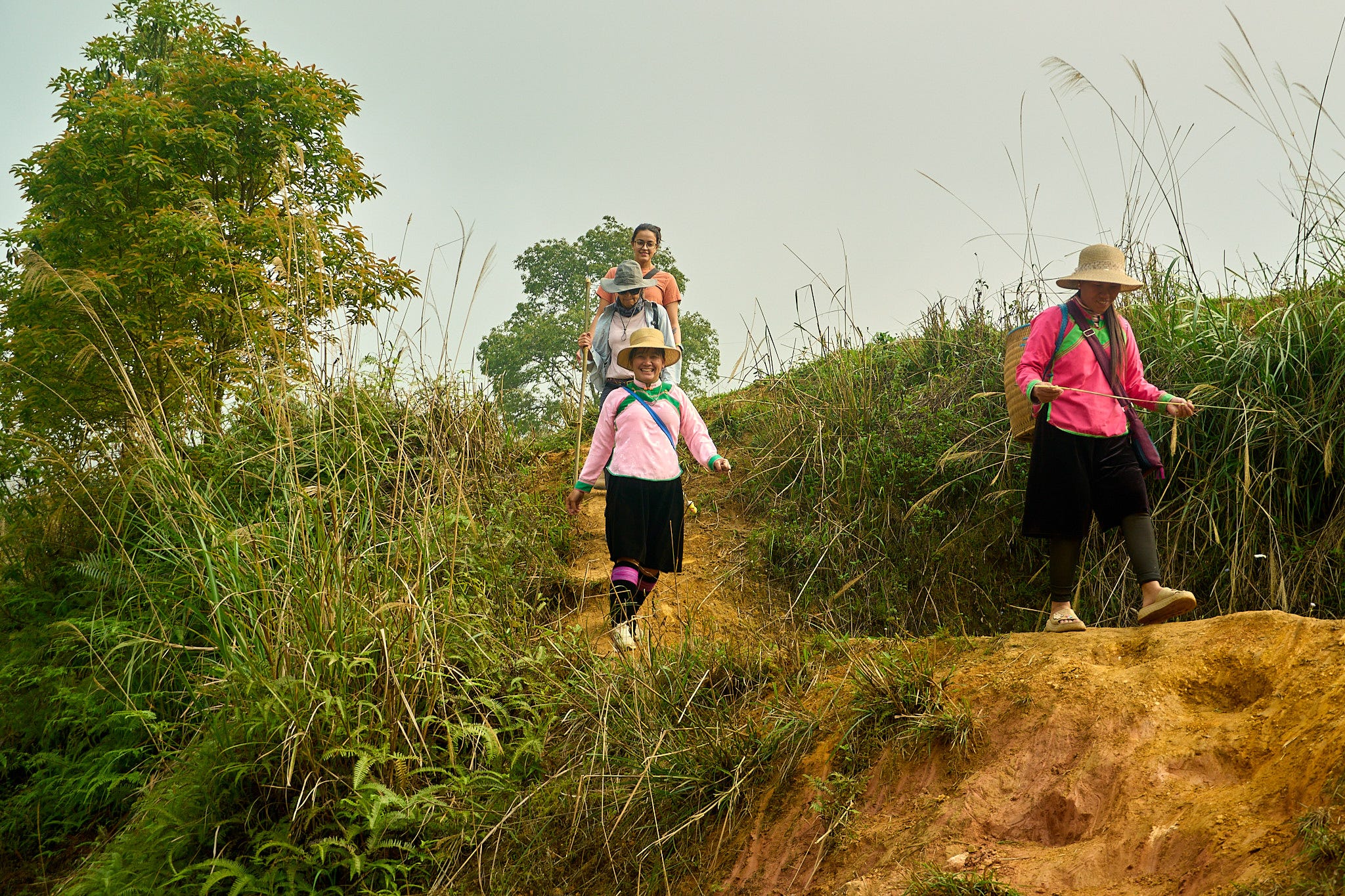
The next day, our guide, Pan, met us early in the morning and she was wearing the same exact outfit as the woman from the day before. The only difference was that she was wearing regular unbranded sneakers. Maybe Pan, being younger than the other woman, had adapted a bit to more modern shoes. But when we were out on the trail, we saw many more guides and most of them wore the same white plastic sandals.
I couldn’t believe I had almost considered getting other shoes for this hike. These women traverse the mountains every day for hours on end because their homes are high on the mountain, the town is really far, there is no public transportation, and they don’t have cars. They walk to tend their rice terraces, walk to town to get food, walk to different hotels and homesteads to fetch the guests then go hike for 8 hours (or 3-day treks) with the guests, then walk back home.
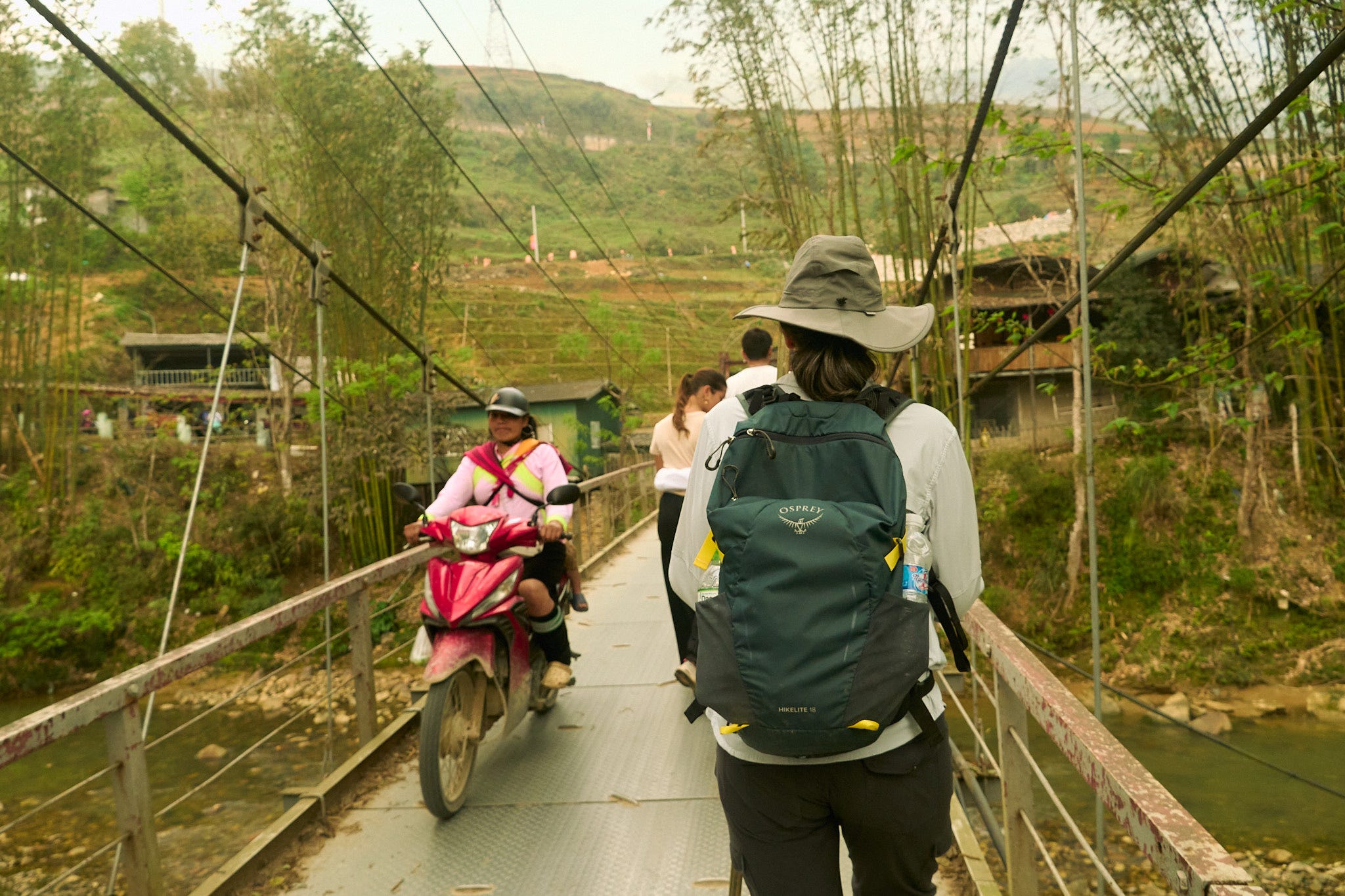
This made me realize I’d become so conditioned to the marketing we get bombarded with. Moisture-wicking hiking pants, waterproof hiking boots, the newest Osprey backpack with extra pockets. Not that there’s anything wrong with these products, but it felt icky to me to feel like the first thought about going on this hike was that I didn’t have the perfect gear for it. We don’t need to have all the gear to do the thing.
Does what we buy dictate our experience?
On the night train leaving Sapa and going back to Hanoi, I shared a carriage with three other strangers, also tourists. They wore white laced dresses and nice platform shoes. Their makeup and hair were perfectly done. They had nice roller luggage neatly tucked under the bunkbeds. The sight of me must have caused them to wonder what jungle I had just busted out of, because I had waltzed in with my big backpack and one shoe completely covered in a mix of red mud and water buffalo poop.
They asked me where I had been. I said Sapa. They seemed surprised because they had been in Sapa too. I explained we stayed at a homestay in the mountains and hired a local Hmong trekking guide and did a day-hike and spent a few days enjoying the scenery and visiting the small villages. They, on the other hand, had stayed in the main town of Sapa and hadn’t ventured out. “You are so adventurous!” they said.
Even though they hadn’t done any of the same activities my family and I had done they said they had a lovely time. It made me realize that despite having visited the same place, we had totally different experiences, but we each still enjoyed ourselves. My initial gut reaction at seeing their pampered well-put-together selves, was to think they clearly hadn’t had a traditional Sapa-in-the-mountains-adventure experience the way I had. I had thought everyone came to Sapa for the nature and hikes. But we all found experiences that suited our preferences, and all had fun in our own ways and in whatever outfits we chose.
Are brands becoming our identity?
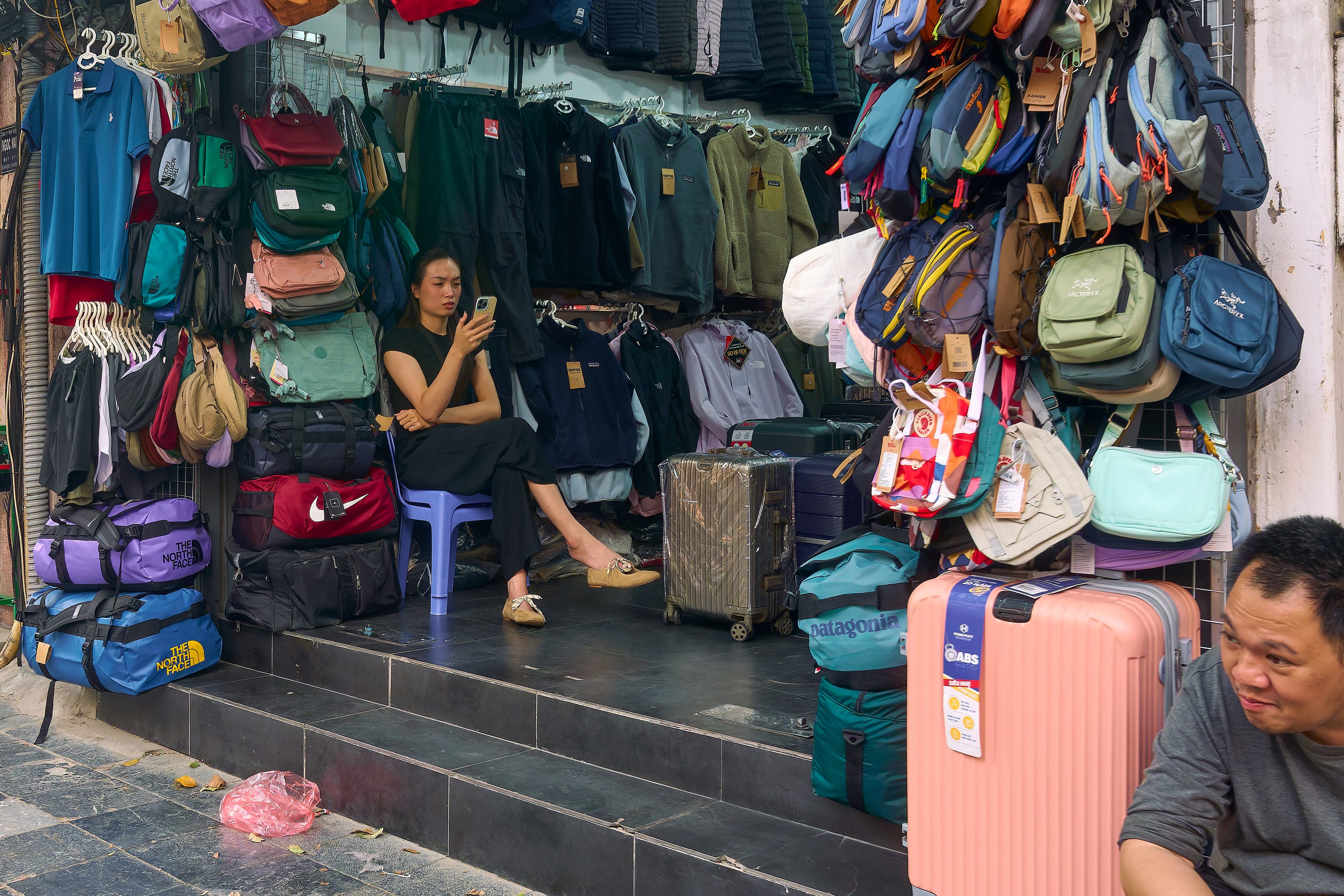
Before leaving Vietnam, we found ourselves yet again meandering around the narrow streets of the old quarter in Hanoi. Shops displayed endless varieties of clothing and accessories, shirts and backpacks on hangers swaying in the breeze. The North Face, Patagonia, Cotopaxi, Adidas, Birkenstock. All the famous brands, all the infamous logos, all sold at all the stores in the same street. Clearly the knockoffs street.
It felt disorienting, coming from rural Sapa with its people of humble and beautiful handmade clothing, to this madhouse that was the knockoffs street. Peak consumerism at its finest. I looked around wondering if these tourists who were purchasing the knockoffs were buying them to go to Sapa for their expeditions.
The “fake” Patagonia rain jacket on display at 1/8th of the price of the exact same “real” Patagonia I was wearing. My sister’s Blundstone boots competing with the fake ones on display. My dad’s Osprey backpack, the exact same as the ones hanging in the shops. All around us, tourists from all over the world sporting Adidas and Lululemon. Suddenly the line between what is real and what is fake, was blurred. It felt like brands and logos were the silliest thing in the world.
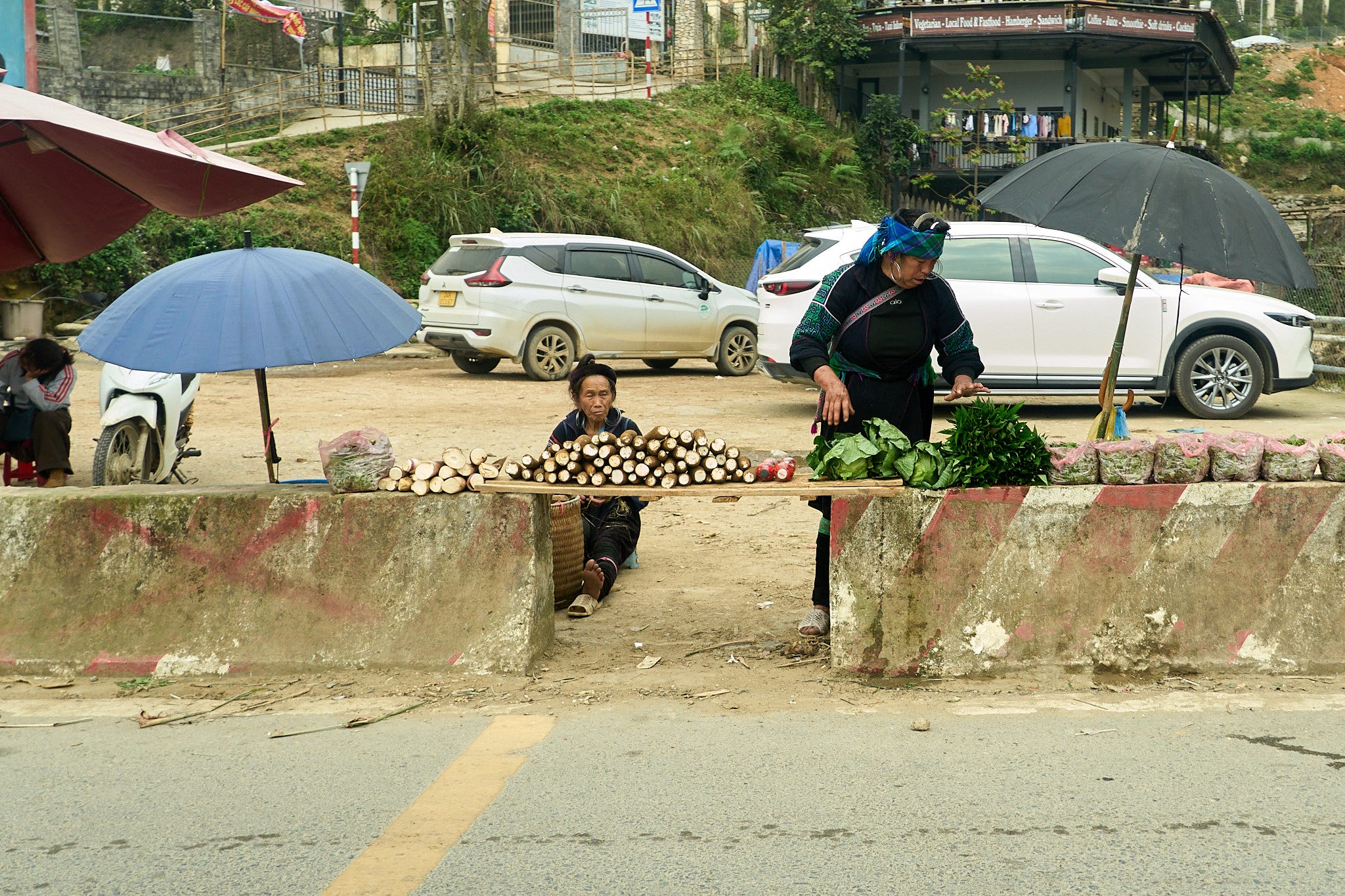
In Sapa, I saw a Hmong woman wearing an Alo branded shirt, a knockoff that probably came from a street just like this one. She didn’t buy it for the brand. She bought it because it was a shirt.
As we walked the streets, I wondered if the Adidas shoes on the lady who just passed me were real or fake. Or if the Cotopaxi backpack a guy was wearing was a knockoff. Are we doing this to fit in? Or because we like the style? Or because it shows others the type of person we are? Maybe we are willing to pay more because we think items will last longer. The absurd amount of money we pay for things with brand names felt really shallow to me the more we walked around the shops.
We begin buying these things because we think it makes us the person who does the thing. If you want to be a runner, you get Brooks. If you want to be a yogi, you get Lululemon. If you want to become an outdoor adventurer who supports sustainability, you get Patagonia. Our purchases start happening before our experience. Shouldn’t it be the other way around?
In conversation with a local Hanoian, they said the quality of all of those knockoff products is actually quite comparable to the real things. Maybe that’s why seeing all the knockoffs in Hanoi made me stop and think about the difference between the real and the fake. Perhaps we seek validation for who we are or who we want to be perceived as, and so we wear logos with the hope that they speak for themselves.
Our clothing does speak for us, as much as it does for the ethnic tribes in Sapa. The Hmong had their indigo clothes and the Red Dao their red headbands. For a lot of us, our clothes are a way to broadcast our identity, whether it’s in the logos we choose to display or the fashions and styles we exhibit.
Add to cart?
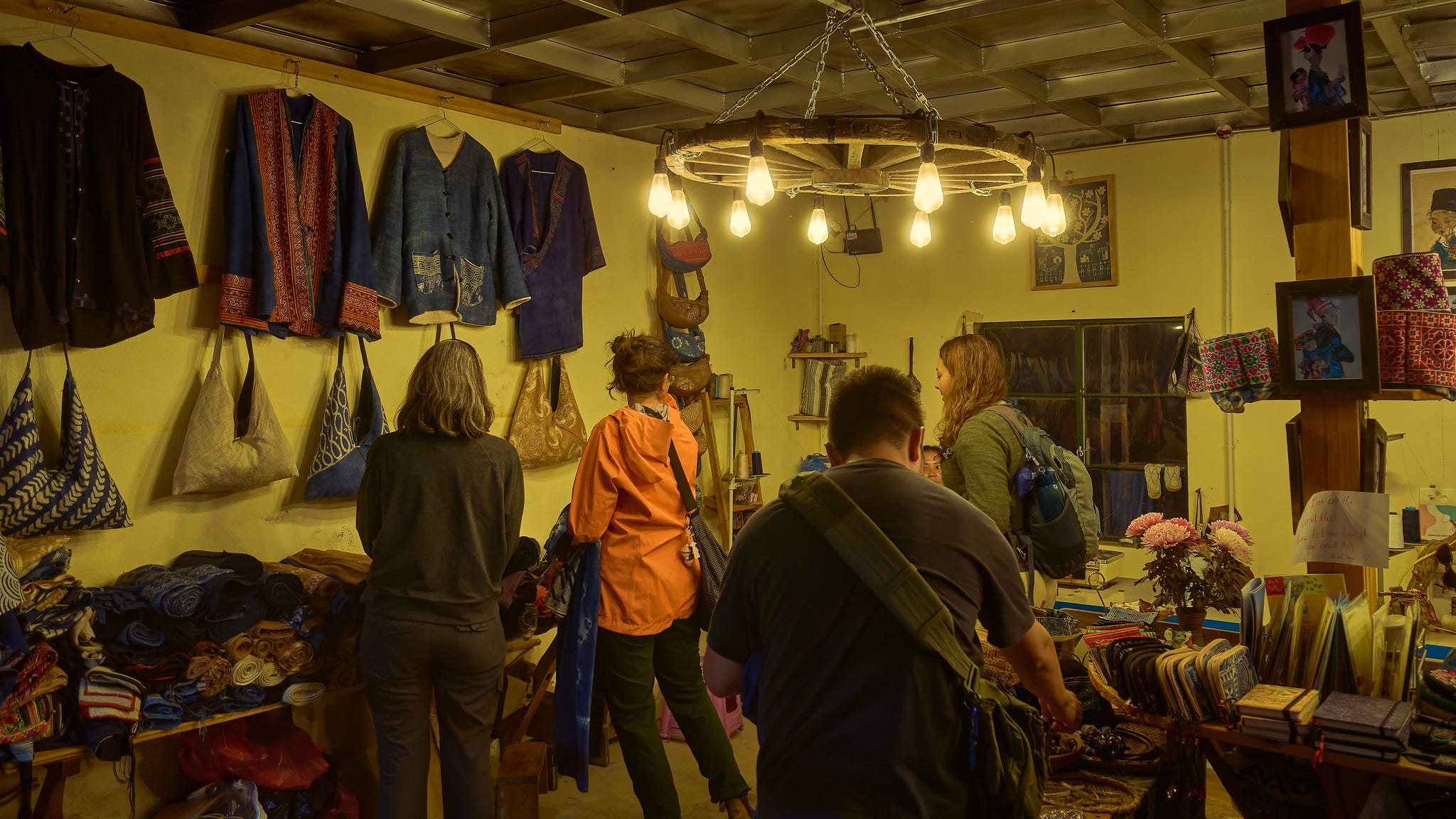
When I got back home and opened my closet, I felt a wave of overwhelm. I pride myself on being minimalistic because I constantly donate clothes I don’t use, but it didn’t feel this way. In Vietnam I had bought custom tailored indigo-dyed shirts and natural hemp pants, and stored them away, piled on top of all my other clothes. It felt heavy.
Since coming back, I’ve been slowly switching my polyester and rayon clothes for linen, hemp, and cotton pieces. That also means I’ve been online shopping quite a bit, which makes the whole thing feel contradictory.
The women in Sapa are still out there right now, hiking up and down their mountains in plastic sandals. They were doing that long before I arrived, and they’ll be doing it long after I’ve left. For me, the way I look at my own stuff has shifted. I won’t be buying plastic slide sandals anytime soon, but it all seems odd to me now.
Do you have thoughts about this topic? Would love to hear them, drop a comment below. Enjoyed this piece, give it a like or share it with a friend. Thanks for reading!
This times a million!!!!! Sure there is absolutely a time and a place for technical gear. But 9/10 you can start with what you have and you’ll be just fine